What should a mobile dog groom cost in Australia? (Spoiler: more than you’re charging)
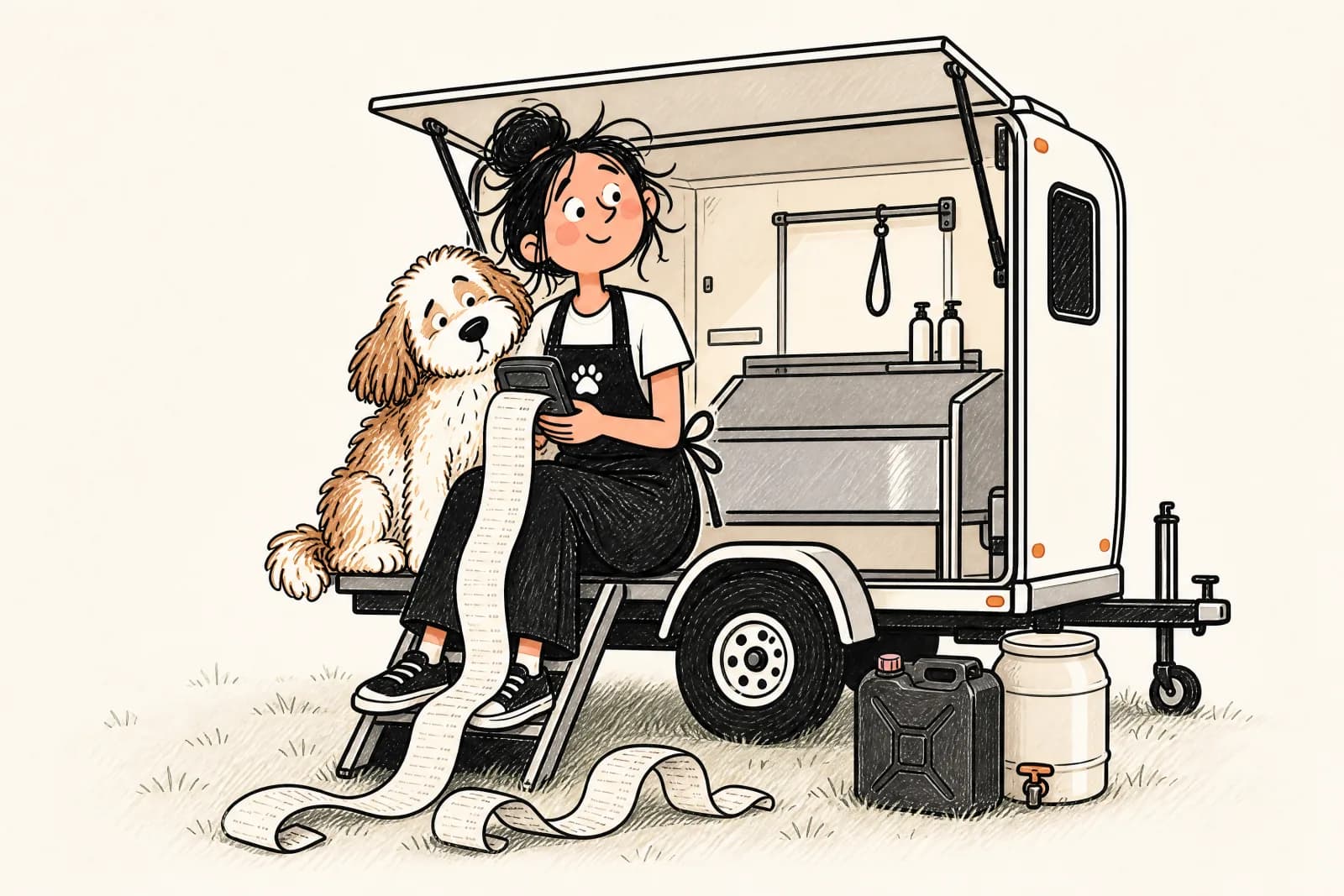
It’s Sunday night. The van’s washed, the towels are tumbling and you’ve finally sat down with a cuppa and a calculator to work out how the week went.
You add up the fuel. Then the shampoo. Then the blade you sent off for sharpening after Tuesday’s doodle. Then the 40 minutes you spent driving out to that cavoodle in the new estate, plus the 40 minutes back, plus the extra half hour the mats added.
And there it is, glowing on the screen: once everything’s counted, that cavoodle cost you more than it paid you.
You didn’t groom a dog. You sponsored one.
If that’s ringing bells, good news: it’s fixable, and it doesn’t involve guessing. Here’s the short answer, then the long one.
The short answer: work out what an hour of your working day really costs (including the hours you spend driving and doing admin, not just the hours with clippers in hand), add the wage you want to pay yourself, then price each groom by how much of your day it takes. Size, coat and condition change the time; the time changes the price. Market rates are a sense check, not a starting point.
Why copying the groomer down the road doesn’t work
It’s tempting. Their prices are right there on Facebook, they seem busy, and nobody’s complained.
But you have no idea what their costs are. Maybe they own the van outright. Maybe they work a tighter area, so they drive half as much. Maybe they’re quietly going backwards and haven’t done their own Sunday-night maths yet.
Even business.gov.au’s pricing guide says to use competitors’ prices as a guide but not to copy them exactly, and to make sure your price covers your costs.
Step 1: Work out your true cost per hour on the road
Start with everything the business spends in a typical month. Not the stuff you remember. Everything.
Here’s where it gets a bit Bunnings. You go in for one thing and come out with a receipt as long as your arm:
- Van or trailer loan or lease repayments
- Insurance (vehicle, public liability, and whatever else your broker talked you into, hopefully for good reasons)
- Rego, servicing, tyres and the generator’s little tantrums
- Fuel, for the van and for the generator if you have one
- Water, and any power or tank refills
- Shampoo, conditioner, ear cleaner, bandanas, bows and the treats that buy you a still face for the eyes
- Blades, sharpening, clipper servicing and the scissors you swore you’d never drop again
- Towels, laundry, and the dryer you’ll need to replace eventually
- Phone and data
- Software, bookkeeping and your accountant
- Advertising, website and business cards
- Super. As the ATO explains, sole traders don’t have to pay super guarantee for themselves, but they can make personal contributions. If you’d like to retire one day, it belongs on the list.
- A buffer for weeks off, sick days and the inevitable "the pump’s gone" moment
Just when you think the receipt’s finished, it keeps printing.
The cost nobody puts on the list: driving
Here’s the big one. Every minute between driveways is a minute you’re working and not being paid for. Same with answering texts at 9pm and re-jigging Thursday because someone’s moved to Wednesday.
So when you count your hours, count the whole day: first drive out to the last drive home, plus admin. That’s your real working day, and your prices have to pay for all of it.
Step 2: A worked example (sample numbers only)
These numbers are made up to show the method. They’re not a recommendation, and yours will be different. Possibly very different.
Monthly costs (example):
- Van repayments: $900
- Insurance: $250
- Fuel: $600
- Rego, servicing and tyres set aside: $200
- Products: $250
- Blades, sharpening and servicing: $120
- Water and refills: $60
- Towels and laundry: $60
- Phone and data: $80
- Software and bookkeeping: $100
- Personal super contributions: $500
Total: $3,120 a month.
The working day (example): five dogs a day, four days a week, which comes to about 16 working days a month once you allow for a few days off. Each day is 7.5 hours of grooming, 1 hour 40 minutes of driving between stops and 50 minutes of admin. That’s a 10-hour day.
Now the maths:
- Costs per day: $3,120 ÷ 16 days = $195.
- The wage you want (example): $40 an hour before tax, for all 10 hours = $400.
- What each day has to bring in: $195 + $400 = $595.
- Your true cost per hour: $595 ÷ 10 hours = $59.50.
That $59.50 is what every hour of your day costs, including the hours behind the wheel.
Turning that into a price per groom
In this example the 2.5 hours of driving and admin, shared across five dogs, works out at 30 minutes per dog. So each groom needs to pay for its grooming time plus half an hour:
- Small, short-coated dog, 1 hour of grooming: 1.5 hours × $59.50 = about $89
- Cavoodle full groom, 1 hour 45: 2.25 hours × $59.50 = about $134
- Large double-coated de-shed, 2.5 hours: 3 hours × $59.50 = about $179
Notice the cavoodle. If you’d been charging the same as the little short-haired dog, that’s the Sunday-night feeling right there.
Swap in your own costs, your own hours and your own wage. The method holds even when the numbers don’t.
Step 3: Price by size, coat and condition
Once you know your hourly cost, a price list is really a list of how long things take you.
- Size is the obvious one. More dog, more time, more product, more drying.
- Coat matters as much as size. A short, smooth coat and a curly, high-maintenance one can be the same size and nowhere near the same job.
- Condition is the wildcard. A dog groomed every five weeks and a dog last seen by a brush at Easter are two different appointments.
- Temperament counts too. The angel at home who becomes a velociraptor in the tub takes longer, and it’s fair for the price to reflect a two-handed job.
Time yourself for a few weeks if you’re not sure. You’ll probably find a few breeds you’ve been undercharging for out of sheer hope.
Matting and de-shedding surcharges
Matting takes longer, is harder on your blades and can mean a shorter clip than the client hoped for. De-shedding a thick double coat can add a serious chunk to the appointment.
Common approaches include a set surcharge, a per-15-minute rate, or "from" pricing that tops up based on condition. Whatever you pick:
- Tell clients before the appointment, ideally in writing with your price list.
- Explain it at the door before you start, not on the invoice afterwards.
- Use it as a nudge towards regular bookings. "Every five weeks keeps the mat fee away" is a pretty friendly way to put it.
Travel and out-of-area fees
Some suburbs are on your way. Some are a 45-minute detour for one dog.
Plenty of mobile groomers set a home area and add a travel fee beyond it, or price by zone. Some only take far-flung clients on days they’re already out that way. Again, the key is being upfront: when clients see the fee before they book, it reads as fair. When it turns up as a surprise, it reads as sneaky.
If you’re registered for GST, remember the price you show clients should be the total price, including GST. business.gov.au’s page on displaying prices covers what has to be included.
How to put your prices up without losing your regulars
Here’s the thing most groomers worry about. In practice, your regulars aren’t paying you because you’re the cheapest. They’re paying you because their dog walks into your van without a fuss and comes out looking like a show dog.
A few ways to make a rise feel normal:
- Give notice. A few weeks’ warning by text or a note with the invoice is respectful and gives people time to adjust.
- Keep it short. "My prices are going up from 1 February, as my costs have gone up. Your groom for Biscuit will be $X." No essay, no grovelling.
- Make it regular. business.gov.au suggests reviewing prices at least once a year, or whenever your costs change. A small rise every year is easier for everyone than a big jump every three.
- Decide about existing clients. Some groomers move everyone at once; some give long-time regulars a later start date. Either is fine as long as you’re consistent.
You might lose a client or two who were only ever there for the price. That’s usually the dog you were sponsoring anyway.
You’re not a charity. Well, unless you are, in which case, lovely.
Why being the cheapest is a trap
Being the cheapest feels like a strategy. It’s mostly a treadmill.
- You attract price shoppers, who’ll leave the moment someone’s $5 cheaper.
- You have to work more dogs to earn the same, which means more driving, more tired arvos and less time per dog.
- There’s no room for anything going wrong, and in a van, something always goes wrong.
- It’s hard to climb back up. Raising prices from "suspiciously cheap" to "fair" is a bigger jump than starting at fair.
The business.gov.au guide also warns that pricing below cost for a sustained period to push competitors out is illegal. You’re not doing that on purpose, but it’s a good reminder that below cost is not a place to live.
What does a mobile dog groom cost in Australia right now?
For context, not advice: Airtasker’s mobile dog grooming cost guide (last updated 25 June 2026, which we checked on 25 October 2026) puts the average at $105 a session, with a range of $55 to $185. Its city ranges include:
- Sydney: $95 to $150
- Melbourne: $90 to $185
- Brisbane: $90 to $180
- Adelaide: $85 to $150
- Canberra: $75 to $130
- Perth: $60 to $125
Airtasker describes these as estimates, and they don’t break down by size or coat. Use them to see where you sit, then go back to your own numbers. If your true cost per groom is above the average, that doesn’t mean you’re expensive. It might mean the average is underpriced.
Keeping an eye on it week to week
Pricing isn’t a one-off job. Fuel goes up, a new estate opens 30 minutes away, you take on a few more doodles than you planned.
This is where your numbers need to be easy to see. In Clippers Base, reports of takings and how people paid show what each day actually earned, so you’re not waiting for Sunday night to find out. And when you add a booking, the app suggests times that fit between stops, with the extra driving for each option, which makes the cost of that 40-minute detour pretty hard to ignore.
However you track it, the goal’s the same: know what an hour of your day costs, and make sure every dog pays for theirs.
Even the cavoodle. Especially the cavoodle.
This is general information, not financial or tax advice. Your accountant knows your numbers; we only know dogs.