GST and BAS for groomers: the non-scary bit
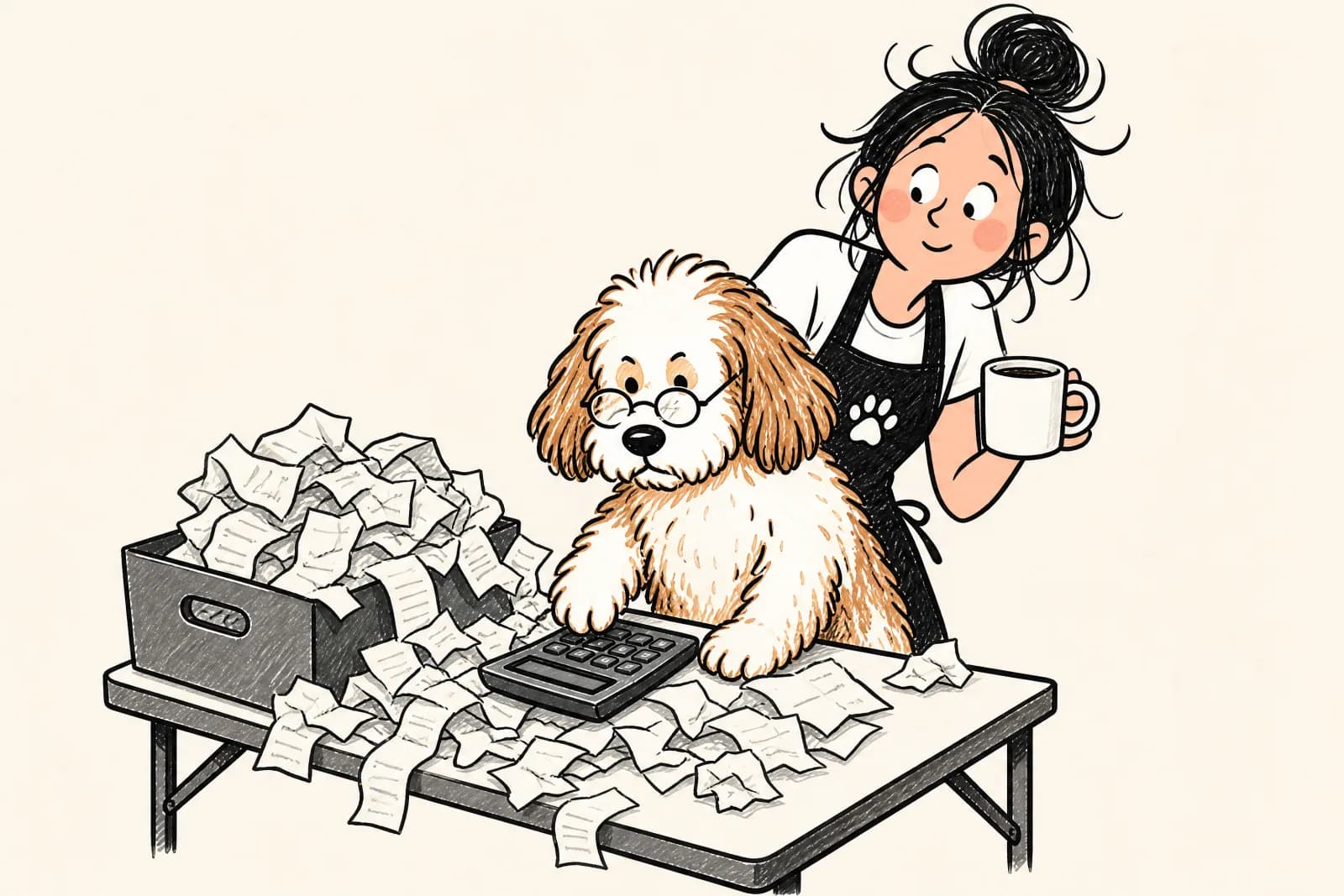
There’s a particular kind of quiet that settles over a kitchen table at 9pm in late October. A shoebox. A calculator. A cup of tea going cold. And a dog in reading glasses who has clearly been asked to help and is taking it very seriously.
If that’s you, good news: GST and BAS are admin, not a horror film. Most of it comes down to a few rules, a few dates and a box of receipts that’s slightly less chaotic than it is now.
Here’s the short version for skimmers. You must register for GST once your business turnover reaches $75,000 a year. Once you’re registered, you add GST to your prices, and you report it to the ATO on a business activity statement (BAS), usually every quarter. Below $75,000, registering is optional.
Now the slightly longer version, with fewer cold cups of tea.
Do dog groomers need to register for GST?
Grooming is a service with no special GST rule of its own (unlike, say, taxi driving, which must register whatever its turnover), so you follow the standard ATO test. According to the ATO’s GST registration page, you must register when your GST turnover is $75,000 or more.
The important bit is how that turnover is measured:
- It’s income, not profit. GST turnover is your total business income, minus a few things such as GST already included in sales. Shampoo, fuel and the new clippers don’t come off it.
- It looks backwards and forwards. You hit the threshold if your current turnover (this month plus the previous 11) is $75,000 or more, or your projected turnover (this month plus the next 11) is likely to be.
- New businesses count too. If you’re starting out and expect to reach $75,000 in your first year, you need to register.
- You have 21 days. The ATO suggests checking each month if you’re not registered, and you need to register within 21 days of going over.
You’ll need an ABN before you can register. If you skip registering when you should have, the ATO can ask for GST on your sales back to the date you were meant to register, even if you never charged it, plus penalties and interest. Which is a very expensive way to learn about thresholds.
Under the threshold? Registering is your choice. Some groomers do it voluntarily, often so they can claim GST credits on big purchases. If you choose to register, the ATO says you generally need to stay registered for at least 12 months, so it’s worth a chat with your accountant first.
What charging GST means for your prices
GST is a 10% tax on most goods and services in Australia. Once you’re registered, it’s built into what you charge.
The handy maths: the GST in a GST-inclusive price is one-eleventh of the total. So a $110 groom (example only) includes $10 of GST. That $10 was never really yours. You’re holding it for the ATO, which is why the ATO’s own advice is to put it aside until it’s due.
A few things change on the day you register:
- Your advertised prices need to include GST. Under Australian Consumer Law, prices you display must be the total price, including taxes like GST. No "$100 + GST" on the side of the van for pet owners.
- You decide what happens to your prices. You can put them up to cover the GST, absorb it, or land somewhere in between. That’s a business call, and it’s worth doing the sums before you register rather than after.
- You can claim GST credits. The GST included in business purchases (shampoo, blades, fuel, equipment) can generally be claimed back. For purchases over $82.50 you need a tax invoice from the supplier.
- Clients can ask you for a tax invoice. If a client asks, you must provide one within 28 days, unless the sale is $82.50 or less.
Not registered? Then you don’t include GST in your prices, your invoices need to show GST wasn’t included, and you can’t claim GST credits.
What a BAS is, and how often you lodge one
A BAS is the form you use to tell the ATO how much GST you collected and how much you paid on business purchases. The difference is what you pay (or, occasionally, get back). Depending on your situation it can also cover other things, like PAYG instalments or tax withheld from staff wages.
For most small businesses it’s less of a form than it sounds. Under Simpler BAS, the default for businesses with GST turnover under $10 million, the GST part comes down to three numbers: total sales, GST on sales and GST on purchases.
How often
There are three rhythms, per the ATO’s due dates page:
- Quarterly is the standard for businesses under $20 million, which is every mobile groomer we can imagine.
- Monthly is optional for you, and due on the 21st of the following month. Some people like smaller, more frequent payments.
- Annually is available if you registered voluntarily and your GST turnover is under $75,000. The annual return is generally due 31 October.
Quarterly due dates
- July to September: due 28 October
- October to December: due 28 February
- January to March: due 28 April
- April to June: due 28 July
If you lodge online, you may get an extra two weeks for quarters 1, 3 and 4 (quarter 2’s due date already includes a one-month extension). Registered tax and BAS agents may have different dates again. If a due date lands on a weekend or public holiday, you’ve got until the next business day.
And if you can’t pay on time, the ATO’s advice is to contact them, or your tax professional, before the due date. Payment plans exist. Silence doesn’t help.
The five stages of BAS grief
Every quarter, a well-documented emotional journey unfolds across kitchen tables nationwide.
- Denial. "It can’t be October. I only just did the last one." It’s October.
- Anger. Directed mostly at the shoebox, partly at yourself, and briefly at the dog, who did nothing wrong.
- Bargaining. "If I get this done by the 28th, I will scan every receipt the day I get it. Forever. I promise."
- Despair. You find the receipt for the new blades. It’s thermal paper. It’s blank. It has faded into a smooth, white rectangle of regret.
- Acceptance. You lodge it. It takes less time than the dreading did. Every single quarter, this comes as a surprise.
The cure for stages one to four is mostly stage three, actually kept. Which brings us to receipts.
Keeping receipts: what records the ATO expects
The ATO’s record-keeping rules boil down to this:
- Keep records of all your business income and expenses. Each record should show the date, amount, what it was for and the GST.
- Keep most records for five years. Generally that’s five years from when you got the record or finished the transaction, whichever is later.
- Split business and personal clearly. If the ute does the school run as well as the grooming run, you need records showing the business portion.
- Be able to show them. If the ATO asks, you need to produce them.
Here’s the bit that saves stage four. The ATO accepts images of paper records, as long as they’re true and clear copies. Once you’ve saved a clear image, you generally don’t need to keep the paper. So photograph the receipt in the Bunnings car park, before it lives in the door pocket for a month and turns into a blank rectangle.
The free ATO app also has a myDeductions tool that sole traders can use to record expenses on the go. Or a folder on your phone. Or anything that isn’t a shoebox.
Cash or invoice basis: which one are you?
When you’re registered, you also choose when GST counts. The ATO calls these the cash and non-cash (accruals) methods. The non-cash one is often called the invoice basis.
- Cash basis: you report GST in the BAS period when you’re actually paid (and claim credits when you actually pay).
- Invoice basis: you report GST in the period you issue the invoice or receive payment, whichever comes first.
Businesses with an aggregated turnover under $10 million can choose either. For a groomer who’s mostly paid in the driveway, the two often come out nearly the same, because the invoice and the payment happen on the same day. The difference shows up with the client who pays three weeks later. On an invoice basis, a groom invoiced on 29 September counts in the July to September quarter even if the money arrives in October. On a cash basis, it waits for the money.
Cash basis tends to suit small businesses because the GST you owe lines up with money you’ve actually received. But it’s your choice, and an accountant can tell you which suits your numbers.
Where Clippers Base fits (and where it doesn’t)
Clippers Base looks after the sales side. For groomers registered for GST, it gives you a BAS summary of sales and GST on sales for each quarter, on a cash or invoice basis, plus reports of your takings and how people paid. The end-of-day sheet asks how each client paid, so the takings are actually recorded rather than reconstructed from memory in October.
What it isn’t: accounting software. It doesn’t track your purchases or the GST on your expenses, it doesn’t lodge your BAS, and it doesn’t replace your accountant or bookkeeper. Think of it as a tidy sales figure you can hand to whoever does your books, rather than the books themselves.
When to get a bookkeeper or accountant
Plenty of groomers lodge their own BAS, and Simpler BAS keeps the GST part to a handful of numbers. But it’s worth getting help when:
- you’re getting close to $75,000 and need to decide what to do about prices
- you’re thinking about registering voluntarily
- you’re buying or fitting out a van or trailer (big purchase, real GST and tax questions)
- you’re taking on staff, which brings PAYG withholding and super into the picture
- you’re behind on lodging, or the shoebox has become two shoeboxes
- your business and personal spending are tangled together
If you use someone, check they’re registered on the Tax Practitioners Board’s public register. A registered tax or BAS agent can also lodge for you, and may have different due dates.
GST and BAS reward boring habits: a photo of every receipt, the GST put aside, a reminder a fortnight before each due date. Do those and the dog can take the glasses off.
And if you’d like your sales and GST on sales already added up each quarter, Clippers Base will have them ready when you are.
This is general information, not tax advice. Your accountant knows your numbers; we only know dogs.
Sources
- Registering for GST (Australian Taxation Office)
- How GST works (Australian Taxation Office)
- Due dates for lodging and paying your BAS (Australian Taxation Office)
- Two week lodgment concession, terms and conditions (Australian Taxation Office)
- GST reporting methods, including Simpler BAS (Australian Taxation Office)
- Choosing an accounting method for GST (Australian Taxation Office)
- Tax invoices (Australian Taxation Office)
- Overview of record-keeping rules for business (Australian Taxation Office)
- Digital record keeping (Australian Taxation Office)
- Register for goods and services tax (business.gov.au)
- Display prices (business.gov.au)
- Public register of tax and BAS agents (Tax Practitioners Board)