How to find more grooming clients (no TikTok dancing required)
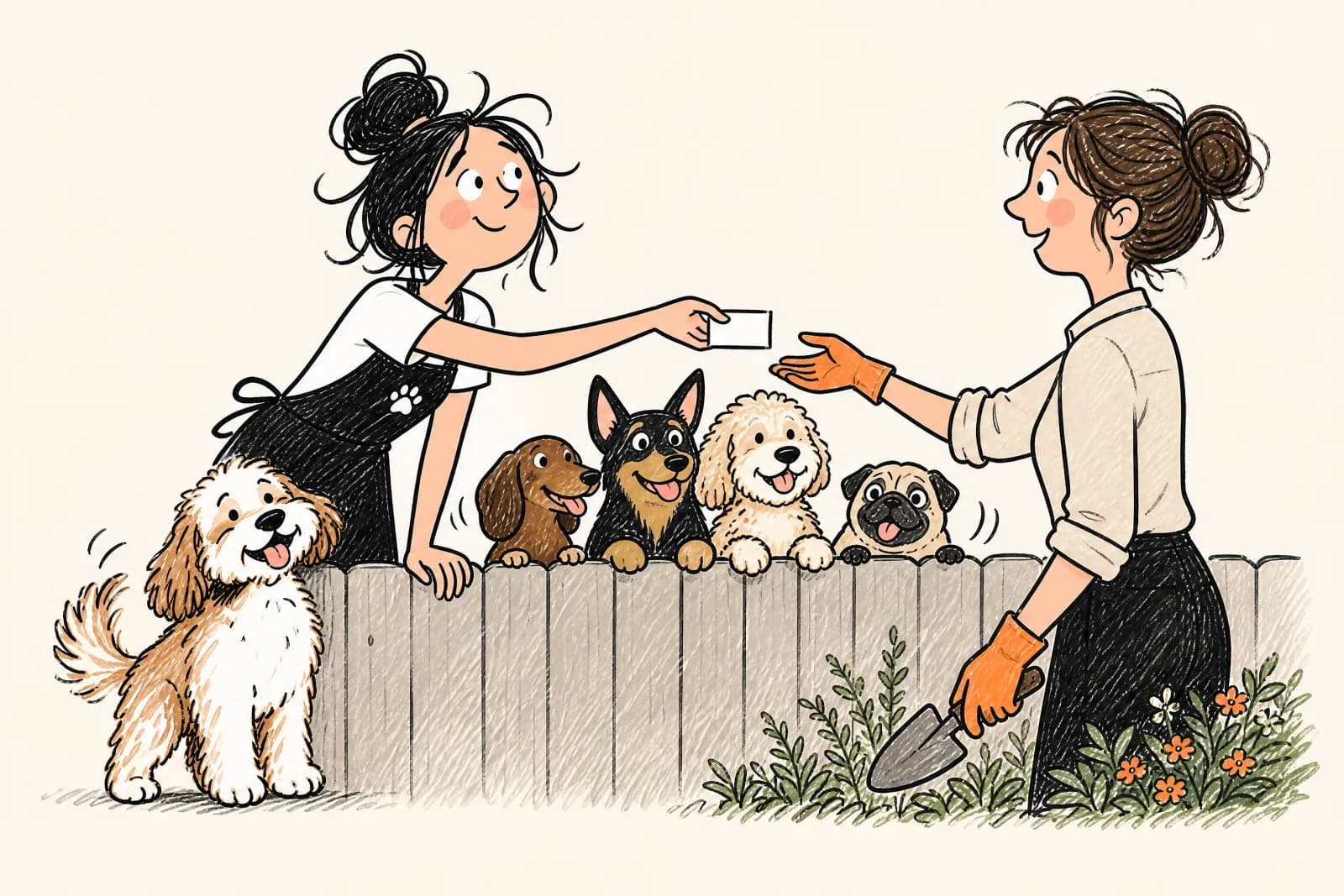
You pull up, unload, and before you’ve even found the tap, there they are. A dachshund. A kelpie with satellite-dish ears. A pug, breathing loudly. A fluffy something that might be part sheep. A whole row of neighbourhood dogs, popping up over the fence to see what all the fuss is about.
And somewhere behind each of those dogs is an owner wondering who does that dog’s hair.
Here’s a secret the marketing gurus won’t sell you a course about: the best marketing is a freshly groomed dog walking past next door. Mobile grooming is local, visible and word-of-mouth by nature. You don’t need to go viral. You need the right people within driving distance to know you exist, trust you, and find it easy to book.
The short version of what actually works:
- A proper Google Business Profile, set up as a service-area business, with honest reviews.
- The neighbours of clients you already have.
- Referrals from happy clients.
- Local Facebook groups, vets and pet shops.
- Your van, and before-and-after photos (with permission).
- Replying to enquiries fast, and making booking easy.
- Keeping the clients you have, which is the most underrated growth plan there is.
No dancing. No 5am content calendar. Let’s go through them.
Set up your Google Business Profile properly
When someone types "dog groomer near me", Google’s local results are prime real estate. Setting up a Business Profile is worth an arvo of your time.
A few things specific to mobile groomers:
- Set yourself up as a service-area business. Google describes this as a business that visits customers but doesn’t serve them at its own address. When creating your profile, answer "No" when asked if you have a location customers can visit, then enter your service area. Google’s page on service areas says that if you don’t serve customers at your business address, you should remove the address from your profile. Handy if you’d rather not have your home on Google Maps.
- Choose your service areas carefully. You can add up to 20 areas by suburb, postcode or region, and Google suggests your overall area shouldn’t be more than about two hours’ drive from where you’re based. Be honest here: listing suburbs you’ll never actually drive to just creates awkward phone calls.
- Get verified. Google says customers can only find your profile after verification is complete.
- Fill in everything. Hours, services, a clear description, and real photos of your work and your van (no client addresses in shot).
Ask for reviews, the honest way
Reviews are the online version of a neighbour leaning over the fence saying "she’s great with nervous dogs". The best time to ask is right after a groom, when the owner is cooing over their dog.
Google’s tips to get more reviews suggest sending customers a review link or QR code, replying to reviews, and valuing all of them, because a mix of positive and negative feedback often feels more trustworthy. Make it easy: one text with the link, sent while the owner is still delighted.
Now, the rules, because there are some:
- Don’t offer anything in exchange for a Google review. Google says offering incentives, like free or discounted services, in exchange for posting, changing or removing reviews is considered fake and misleading content and is strictly prohibited. That’s Google’s own rule, and it’s stricter than the general law.
- No fake reviews. The ACCC says it’s against the law for a business to create fake or misleading reviews, or arrange for others to.
- Mum doesn’t get to review you. The ACCC says reviews can mislead if they’re written by family, employees or people paid by the business without stating that connection.
- Don’t bury the bad ones. Suppressing or removing genuine negative reviews can mislead consumers too. Reply politely instead. Google’s advice is to be professional, keep it short, and take complex issues offline.
The ACCC’s general rule on incentives is that if they’re offered, they must apply whether the review is positive or negative and be clearly disclosed. But since Google bans them outright for its reviews, the simplest approach is: just ask nicely.
Start with the neighbours of clients you already have
Every client’s street is full of dogs, and the neighbours have already seen your van parked out the front. That’s a warm introduction you didn’t have to pay for.
- Carry cards. When a neighbour wanders over to ask "Who are you? What’s that? Does it hurt?", hand one over. It’s the oldest trick in the book because it works.
- Mention it to your client. "If anyone in the street ever asks, I come through here every few weeks." People love recommending things they’re happy with.
- Group your days by area. If you’re already in a suburb on Tuesdays, an extra dog two doors down is a short walk rather than a long drive.
Referrals: make it easy to say your name
Happy clients already talk about their groomer. Help them along. Some groomers offer a small thank-you for a referral, like a nail trim or a discount on the next groom. That’s a referral reward, which is different from paying for a review. Keep the two separate.
The simplest referral tool is still a card or a link they can forward. If they have to remember your business name and search for it, a fair few of them won’t.
Local Facebook groups
Community and pet groups are where people ask "Can anyone recommend a groomer who comes to you?" several times a week.
- Read the group rules first. Many only allow business posts on certain days, or not at all.
- Be helpful, not salesy. Answer questions about matting, summer clips or nervous dogs. People remember the groomer who gave a straight answer.
- Respond when someone asks for a recommendation, even if a client has already tagged you.
Vets, pet shops and noticeboards
Local vets, pet shops, dog trainers, doggy daycares and dog walkers all meet the owners you’d love to groom.
- Drop in, introduce yourself, and ask if you can leave a few cards or pin a flyer to the noticeboard.
- Offer to be a name they can pass on for nervous, elderly or less mobile dogs, where a groom at home is genuinely handy.
- Don’t claim anyone recommends you unless they’ve actually agreed to.
Your van is a billboard
Your van or trailer is parked in front of a house for an hour or more at a time, in exactly the suburbs you want to work in. Clear signage with your business name, what you do, your phone number or website, and the areas you cover turns every booking into a bit of advertising.
Keep it simple and readable from across the street. Your cleverest pun is less important than your phone number.
Before-and-after photos (with permission)
Nothing sells a groom like a dog who went in looking like a hay bale and came out looking like a dog. Before-and-after photos are perfect for your Business Profile, website and socials.
Two rules:
- Ask the owner first. Most say yes. Some will be thrilled.
- Check the background. No house numbers, number plates, faces or anything that gives away where a client lives.
Turn enquiries into bookings, fast
Someone messages asking if you can do their spoodle. This is the moment that matters. If they’ve messaged three groomers, the first clear reply has a head start.
- Reply quickly, even if it’s just "Yes, I cover your area, can I grab a few details?"
- Ask for what you need in one go: address, the dog’s name, breed, size, coat condition and any behaviour or health notes.
- Offer a time. "I’m in your suburb on Thursday, would 10am work?" beats "Let me know when suits."
If you use Clippers Base, you can add a new enquiry as a lead and the app texts them an intake form for the address and the dog’s details, so you’re not playing twenty questions over messages.
Keep the clients you already have
Finding new clients is great. Keeping the ones you’ve got is usually a lot less effort than fishing in Facebook groups.
Rebook before you leave
The best time to book the next groom is at the end of this one. The dog looks great, the owner is happy, and your diary is right there. "Same time in six weeks?" is the single most useful sentence in your business.
Check in with regulars who’ve gone quiet
Life gets busy and people drift. A friendly text is often all it takes to reconnect. The hard part is noticing who’s gone quiet: Clippers Base shows a list of regulars who’ve gone longer than usual between grooms, and it has a waitlist for filling the gaps (more on that below).
One thing to know: a "Time for Biscuit’s next groom?" text can count as a marketing message under the Spam Act. The ACMA says you need consent to send marketing messages, and each one must identify you as the sender, include your contact details and make it easy to unsubscribe (for example, "Reply STOP"). The ACMA says consent can sometimes be inferred from an ongoing relationship, but express consent is best practice. So ask clients at the first groom whether they’re happy to get the odd reminder text, and respect it when someone says no.
Use a waitlist to fill gaps
Cancellations happen. A waitlist turns a gap into an opportunity: when a slot opens, offer it by text to clients who’ve asked to be on the list. The ones whose dog is getting shaggy will often jump at it.
What you can happily skip
You don’t need a viral video, a personal brand, a podcast or a rise-and-grind morning routine. You don’t need to be on every platform. You definitely don’t need to dance.
Mobile grooming grows the old-fashioned way: good work, done reliably, in front of the neighbours. Do the basics well and keep turning up.
The row of dogs over the fence isn’t going anywhere. Neither are their owners, who’ve just watched you walk out of a gate with a dog who looks fantastic. Hand them a card.
And when they ring, Clippers Base can take it from there, from intake form to invoice.
This is general information, not legal advice. Review and spam rules can change, so check the ACCC and ACMA if you’re unsure; we’re mostly here for the dogs.