No-shows: the polite, firm and completely legal guide
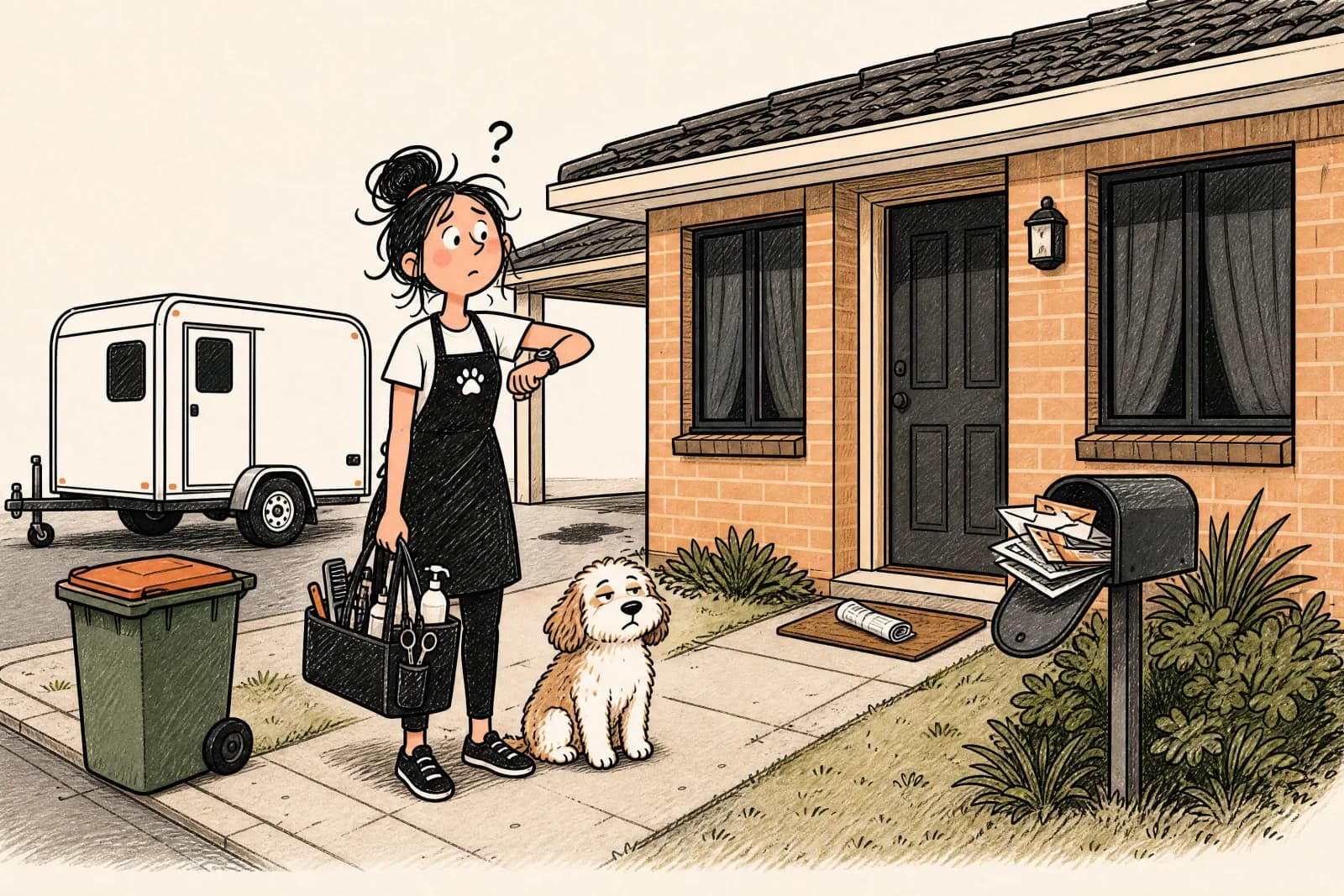
You knock. Nothing.
You knock again, louder, in the tone of someone with a 10am booking and a van idling on the kerb. Curtains drawn. Three days of junk mail poking out of the letterbox. This morning’s paper still on the mat. Inside, nothing. Not even a bark.
Welcome to the no-show. Every mobile groomer has stood on this doormat.
The short version of how to make it happen less, without becoming the villain of your suburb:
- Write a clear cancellation policy, with a notice period and a fee that reflects what a late cancellation actually costs you.
- Get clients to agree to it before the first groom, in writing.
- Remind people and ask them to confirm.
- Be kind the first time. Most no-shows are forgetful, not malicious.
- Keep it fair, because Australian Consumer Law has opinions about unfair terms, and since November 2023 those opinions come with penalties.
Most no-shows aren’t villains
It’s tempting to picture the no-show client cackling somewhere. Mostly, they’re at Woolies. Or work. Or they genuinely thought it was next Tuesday.
People book six weeks out, then life happens. Your booking lives in their head right next to "renew rego" and "ring Mum back". A good system assumes forgetfulness, not malice, and that sets the tone for everything else.
The excuses hall of fame
Some favourites from general groomer folklore:
- "The dog ate my calendar." (The dog has never shown interest in stationery.)
- "I thought you said next Thursday." (It was booked from their own suggestion. Last week.)
- "We were home, we just didn’t hear you." (Through the knocking, the doorbell and eleven straight minutes of barking.)
- "I wrote it on the fridge calendar." (The fridge calendar is from 2023.)
- "He knew you were coming, so we thought we’d let him off this time."
Laugh, then fix the system. The excuse doesn’t really matter. What matters is the hole in your diary and whether the client knew the deal.
What a good cancellation policy covers
It doesn’t need to be long, just clear enough that a tired person can read it on their phone and know where they stand. Cover:
- How much notice you need to cancel or move a booking without a fee. 24 or 48 hours is common.
- What happens with a late cancellation.
- What happens with a no-show: you arrive and nobody’s there.
- How long you’ll wait at the door before it counts.
- What happens if you cancel or run very late. This matters more than you’d think.
- When you’ll waive the fee: emergencies, a sick dog, or when you fill the slot.
- How and when you’ll charge it.
Write it the way you talk. "If you cancel with less than 24 hours’ notice" beats "In the event that the Client fails to provide adequate notice" every day of the week.
What’s a reasonable no-show fee?
Here’s the question to ask about any number you put in your policy: could I explain this fee as what the cancellation actually cost me?
A late cancellation costs you the slot (if you can’t fill it), the drive, and sometimes the next client’s timing. That’s a real loss, and it’s fair to recover it. A fee designed to punish is a different thing.
Regulators are fairly plain about this. Consumer Affairs Victoria’s cancellation guidance says to make sure any fees or charges reflect reasonable costs, otherwise they may be seen as penalties, which generally can’t be enforced. WA’s Consumer Protection Commissioner says much the same.
So, as an example only, a policy might say:
- 24 hours’ notice or more: no fee, rebook any time.
- Less than 24 hours’ notice: 50% of the groom price.
- No-show after you’ve driven there: up to the full groom price.
- And if you fill the slot from your waitlist, you waive it.
That last line is the secret weapon. It makes the fee obviously about your lost time, not a fine, and it makes you look like the reasonable human you are.
What about deposits?
Some groomers take a deposit from new clients or for long grooms. Disclose it upfront and keep it proportionate. The same Victorian guidance (written for tourism bookings, but the principle travels) notes that deposits greater than 10 per cent of the total cost may be considered prepayments, which customers may not have to forfeit if they cancel. Planning to keep a 50% deposit? Get advice first.
The legal bit: unfair contract terms
Your cancellation policy is part of a contract. Send the same terms to every client on a take-it-or-leave-it basis and you’ve got a standard form contract, which business.gov.au describes as one a business prepares that gives the consumer little or no opportunity to negotiate. The Australian Consumer Law protects consumers from unfair terms in those.
According to the ACCC, a term is unfair if it:
- causes a significant imbalance in the rights and obligations of the parties,
- isn’t reasonably necessary to protect the legitimate interests of the business, and
- would cause financial or other harm to the other party if enforced.
The law’s examples of terms that may be unfair include ones that penalise one party (but not the other) for breaching or ending the contract. A policy that charges the client for cancelling late but says nothing about the groomer cancelling late is a bit lopsided. A line about your own commitments fixes that.
Courts also look at whether a term is transparent: plain language, clear and not hidden. A fee buried in paragraph nine of a PDF nobody opened doesn’t help you.
Why this matters more since 2023
Before 9 November 2023, a court could declare an unfair term void, and that was that. Now, proposing, using or relying on unfair terms in standard form contracts is banned and penalties apply, for contracts made or renewed from that date. The maximums are eye-watering: the greatest of $50 million, three times the benefit or 30 per cent of turnover for businesses, and $2.5 million for individuals.
Nobody’s suggesting a regulator is coming for your late fee. The point is simpler: a fair, clear, balanced policy is easier to enforce and much easier to explain to a cranky client on the phone.
A sample cancellation policy you can adapt
Swap in your own numbers, and if you’re unsure, have a lawyer look over your final version.
The policy
Cancellations and missed appointments. Life happens, so here’s how it works. If you need to cancel or move a groom, please let me know at least 24 hours beforehand and there’s no charge.
With less than 24 hours’ notice, a late-cancellation fee of 50% of the groom price applies. If I arrive and can’t reach you or your dog, I’ll wait 10 minutes and try to call. After that, a missed-appointment fee of up to the full groom price applies, because I’ve driven out and kept the time free for you.
If I can fill your spot with another client, I’ll waive the fee. I’ll also waive it for genuine emergencies, including a sick dog.
If I need to cancel or I’m going to be more than 30 minutes late, I’ll let you know as early as I can, and you’ll never be charged for a visit I can’t make.
I’ll always send a reminder before your groom. Please reply to confirm.
Get the "yes" before the first groom
A policy only works if the client agreed to it before there’s a problem. Springing it on someone after their first no-show is how you earn a one-star review.
- Send it with your first booking confirmation and ask them to reply "yes". Keep that reply.
- Put it on a page you can link to, so it’s easy to find later.
- Say it out loud at the first groom: "I need 24 hours’ notice to cancel, and I’ll always remind you the day before."
That last one works better than it should. People remember what a person told them far better than what a PDF said.
Reminders and confirmation requests
The most useful habit is asking people to confirm. A reminder tells them you’re coming. A confirmation request makes them actually think about whether they’ll be home.
- When booked: a confirmation, with a short line about your policy.
- A few days out: "Can you confirm Biscuit’s groom on Thursday at 10am?"
- The day before: a reminder.
- Morning of, still unconfirmed: a quick call before you drive over.
In Clippers Base, those texts go from your own verified mobile number, so clients reply to you as normal: a confirmation request with a tap-to-confirm link, and a reminder the day before. You can change the wording, so there’s room to add a short line about your policy. On the Today screen, "Worth a look" shows who hasn’t confirmed, so you can ring them before you’re on their doormat.
What to say when it happens
Copy, paste, tweak. Keep the tone warm and the facts clear.
On the doorstep
Hi [Name], it’s [You] from [Business]. I’m out the front for [Dog]’s 10am groom but can’t raise anyone. I’ll wait 10 more minutes, then I’ll need to head to my next client. Give me a call if you’re nearby.
The first no-show (be kind)
Hi [Name], sorry we missed each other today. These things happen. Would you like to rebook? Just a gentle reminder that my cancellation policy applies to missed appointments from here on: [link]. Thanks!
Waiving the fee the first time buys a lot of goodwill, and you’ll soon know if it was a one-off.
The second no-show (be clear)
Hi [Name], I came by for [Dog]’s groom at 10am today but couldn’t reach anyone. As per the cancellation policy you agreed to when you first booked, a missed-appointment fee of $[amount] applies. I’ll send that through shortly. Happy to rebook whenever suits.
A late cancellation
Thanks for letting me know, [Name]. As it’s less than 24 hours’ notice, the late-cancellation fee of $[amount] applies, but if I can fill the spot I’ll waive it. I’ll let you know either way.
Then actually let them know. That’s what makes the policy feel fair.
Fill the hole if you can
An empty slot hurts less if someone else gets it. Keep a list of clients who’d happily come earlier: the shaggy doodle, the work-from-homer, the one who said "call me if anything comes up". Clippers Base has a waitlist for this: when a slot opens, you can offer it to waiting clients by text. If someone grabs it, waive the fee for the client who cancelled.
When to quietly let a client go
Most clients who miss once never do it again. A few miss repeatedly, cancel late every second visit or argue every fee. At some point the kindest thing for both of you is to stop booking them: say, after the third miss despite reminders and a chat, or when every fee becomes a negotiation.
No dramatic exit needed:
Hi [Name], thanks for having me look after [Dog]. My diary has got a lot tighter and I’m not able to keep a regular spot for you anymore. I’d recommend trying [other local option] for future grooms. All the best to you both.
Polite, final, no blame. Then give the slot to someone on your waitlist who’ll answer the door.
No policy stops every no-show. People forget, dogs get sick, and the fridge calendar will always be from 2023. But a clear, fair policy, agreed upfront and backed by good reminders, gives you the best shot at fewer silent doorsteps and far less standing around holding a grooming bag.
And if your reminders still live in a notebook and a hope, Clippers Base can send them for you.
This is general information, not legal advice. For a policy you’re unsure about, a lawyer or your state’s consumer affairs office knows the law; we mostly know dogs.