Van or trailer? The great mobile grooming debate, settled (mostly)
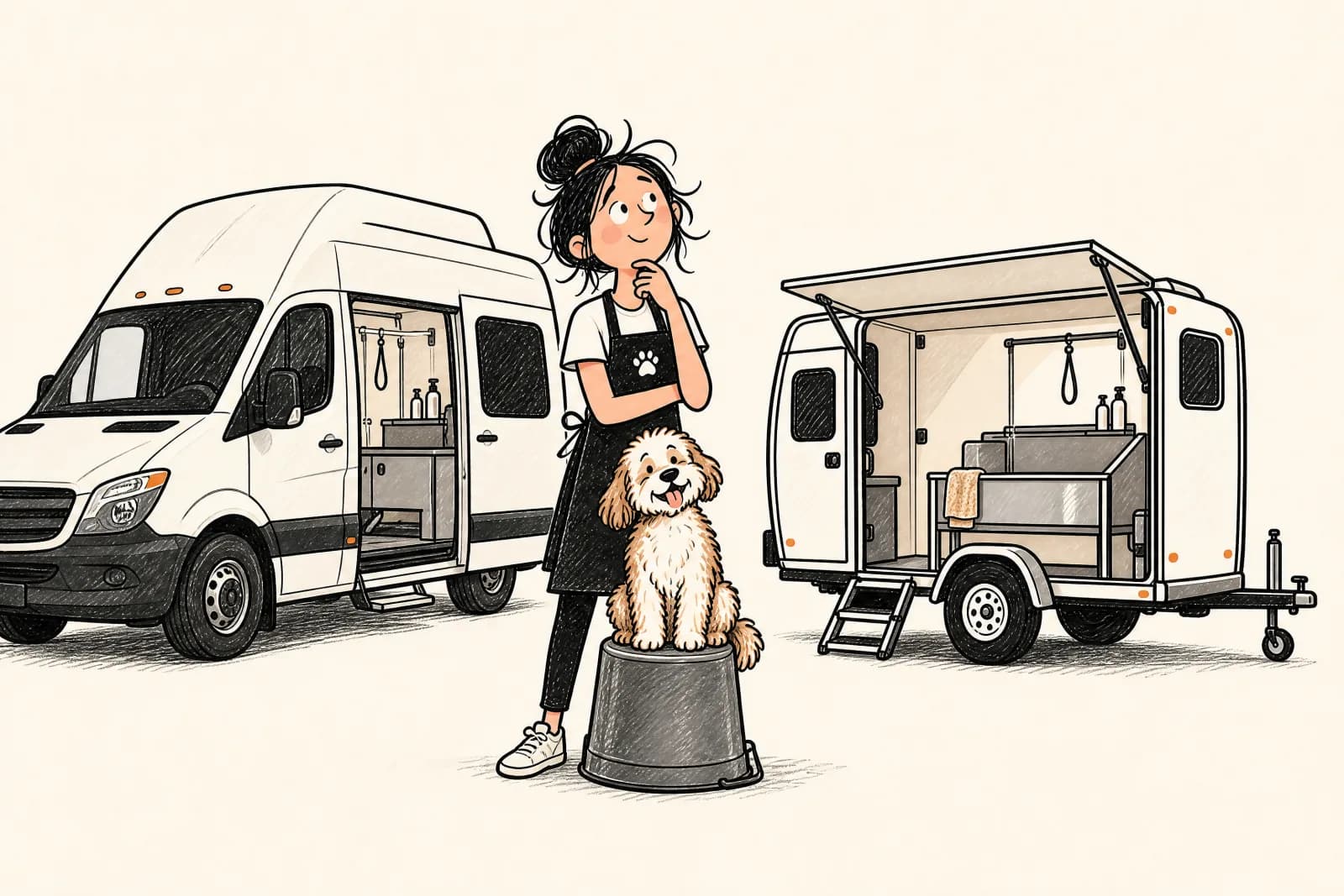
Welcome to the grand final nobody asked for but every new mobile groomer ends up hosting in their own head at 2am.
In the white corner: Team Van. One vehicle, drive it, park it, groom in it.
In the other white corner (they’re both white, it’s a grooming thing): Team Trailer. A salon on wheels that hitches to a car or ute, and unhitches when you’d rather it didn’t come to Woolies.
Officiating today is the dog. The dog has been given a whistle, an upturned bucket to sit on and absolutely no training in sports law. The dog’s rulings are final, except when there’s a treat involved.
Here’s the honest answer up front, for skimmers: neither wins outright. A van usually suits tight suburban runs and people who want fewer moving parts. A trailer usually suits groomers who already own a capable tow vehicle, want the salon separate from the engine, or work larger blocks and regional runs. The rest of this post is how to work out which one is you.
Ball up.
Round 1: Upfront cost
There’s no honest single number here, because prices swing wildly with size, age, fit-out and whether you buy new, used or build your own. So instead of guessing, here’s the shape of it.
A trailer is often the cheaper way in if you already own a vehicle that can legally tow it. You’re only buying the salon. If you’d need to buy a suitable tow vehicle as well, that advantage shrinks, and sometimes disappears.
A van is one purchase: vehicle and salon in one. That’s a bigger cheque, but it’s one cheque.
Get quotes for both, and include the tow vehicle in the trailer column if you don’t already have one.
Umpire’s call: Trailer, on points, with an asterisk the size of a bath.
Scoreboard: Van 0, Trailer 1
Round 2: Running costs
Team Van brings one engine, one registration and one service schedule. Simple. The catch is that a fitted-out van carries water, equipment and a bath everywhere it goes, including on the days you’re just ducking to the shops.
Team Trailer brings two registrations (the tow vehicle and the trailer) and two things to maintain. Trailers have their own wheel bearings, tyres, brakes and coupling to look after, and the NSW towing guide suggests checking bearings, suspension and brakes before each towing trip. Towing a heavy box around is rarely kind to a fuel bill either. On the other hand, on your days off the trailer stays home and you’re driving a normal car.
Insurance is a factor for both. Whichever you choose, check your policy covers business use and the fit-out, not just the vehicle.
Umpire’s call: Draw. The dog looked at both spreadsheets and lay down.
Scoreboard: Van 0, Trailer 1
Round 3: Licences and towing rules
This round has the most fine print, and the fine print changes depending on which state you’re in. So treat this as what to ask, then check with your state transport authority.
For a van, the main question is weight. In NSW, a standard car licence (class C) covers vehicles up to 4.5 tonnes gross vehicle mass (GVM). Above that you need a light rigid (LR) licence. Plenty of vans are rated under that, but not every large one is, and a fit-out with full water tanks adds real weight. Check the van’s GVM rating before you buy, and make sure the loaded van stays within it.
For a trailer, there’s more to learn. Using NSW as an example:
- The loaded trailer can’t weigh more than the lowest of the towbar’s rating, the vehicle’s towing capacity, the trailer’s own capacity and the tyres’ rating.
- Brake requirements step up with weight. Trailers over 750 kg gross trailer mass need brakes, and those over 2 tonnes need brakes on all wheels plus an automatic breakaway system.
- Newer drivers have limits. In NSW, P1 drivers can only tow trailers up to 250 kg unloaded, which rules out a grooming trailer.
Expect the trailer to need its own registration, too. Queensland’s towing page, for one, says the vehicle and the trailer must both be roadworthy and registered.
Other states have their own versions. Start with VicRoads in Victoria, or the transport authority in your state or territory. Don’t assume a rule you read about one state applies in another, including the ones above.
And there’s the skill side. Reversing a trailer into a client’s driveway with the neighbours watching is a learnable art. It is also, at first, a public performance.
Umpire’s call: Van. Fewer rules to learn, no reversing recital.
Scoreboard: Van 1, Trailer 1
Round 4: Parking in tight suburban streets
Every groomer knows the street. Cars on both sides, a bin out the front of every house, and a single space that is definitely shorter than it looked from the corner.
A van is one unit. If it fits, it fits. A car and trailer together are longer, and you can’t always pull into a space nose-first and call it a day. Some driveways help, some cul-de-sacs help, and some streets help absolutely nobody.
Where you park overnight matters too. Councils and strata committees have opinions about trailers in streets and driveways, so check your council’s rules before the trailer moves in.
Umpire’s call: Van, comfortably. The dog has seen you try to parallel park a trailer and would rather not discuss it.
Scoreboard: Van 2, Trailer 1
Round 5: Setup time at each stop
Van: pull up, handbrake on, maybe a step down and the power on, and you’re grooming.
Trailer: it depends on the trailer. Some groomers work with it still hitched and are just as quick. Others unhitch, level it, drop the jockey wheel and pull the steps out. Either way, there tend to be a few more moving parts between arriving and starting, and on an eight-stop day those few minutes add up.
Umpire’s call: Van, by a whisker.
Scoreboard: Van 3, Trailer 1
Round 6: Water and power
Here’s a plot twist: this round is mostly about the fit-out, not the chassis. Both rigs can carry clean and grey water tanks, a water heater, and either a generator or a battery and inverter setup. How big, how quiet and how long it lasts comes down to who built it and what you paid.
Things to ask either way:
- How many dogs can you wash before refilling? Big double-coated dogs count for about three.
- Where does grey water go, and what do your council and water authority allow?
- If there’s a generator, how loud is it at 8am in a quiet street? Neighbours have ears.
- Can you run the dryer and the clippers at the same time without everything going dark?
Umpire’s call: Draw. The dog would like it noted that the water is always either too hot or too cold, regardless of rig.
Scoreboard: Van 3, Trailer 1
Round 7: Resale
With a van, the salon and the engine are welded together, financially speaking. When the kilometres pile up, the whole package ages at once, and a buyer has to want both the van and the fit-out.
With a trailer, the salon has no engine to wear out. You can sell the tow vehicle and keep the trailer, or the other way round. The market for used grooming trailers is a niche one, but so is the market for used grooming vans.
Umpire’s call: Trailer. Flexibility counts.
Scoreboard: Van 3, Trailer 2
Round 8: When it breaks down
This is the one that keeps people up at night.
If the van breaks down, your vehicle and your salon are both off the road. Until it’s fixed, you’re rescheduling the week.
If the tow vehicle breaks down, the salon is fine. Borrow or hire a vehicle that’s rated to tow it, and you might still make your afternoon. A trailer can still have its own bad days (bearings, tyres, a flat in an awkward spot) but it’s rarely a whole-business outage.
Umpire’s call: Trailer, clearly.
Final siren. Scoreboard: Van 3, Trailer 3.
The result: a draw (and why that’s the honest answer)
Yes, a draw. The dog has blown the whistle, eaten the whistle, and declared that "it depends" is a perfectly good result.
It really does depend, mostly on the kind of run you do.
Dense suburbs (lots of stops, tight streets, short drives): the van’s parking, setup and simplicity usually matter most. When you’re in and out of eight driveways a day, small frictions add up.
Regional and semi-rural runs (fewer, longer drives, bigger blocks and driveways): the trailer’s flexibility and breakdown resilience come into their own, especially if you already have a solid tow vehicle for the highway.
Mixed runs: honestly, look at your current or planned client list on a map. Count the streets you’d dread with a trailer behind you.
Which one are you? A quick checklist
You might be Team Van if:
- most of your clients are in tight inner or middle-ring suburbs
- you don’t already own a vehicle that can legally tow a loaded grooming trailer
- you’re not keen to learn towing and reversing, or you’re on restricted plates
- you want to arrive and start grooming with the least fuss
- you’d rather maintain one vehicle than two
You might be Team Trailer if:
- you already own a ute or 4WD with the right towing capacity
- you want your salon to survive your vehicle having a bad day
- your runs are regional, semi-rural or full of wide driveways
- you like the idea of driving a normal car on your days off
- you want to be able to sell or replace the vehicle and the salon separately
If you ticked a mix of both, welcome to the club. Go and sit in a few of each, talk to sellers and builders about real weights, and check the rules in your state before you hand over any money.
Whichever rig wins your heart, it’ll need looking after. Clippers Base keeps equipment reminders for the blade, the filter and the trailer service, which is one less thing living on a sticky note on the dashboard.
Now go forth and groom. The dog has a bucket to get back to.
This is general information, not legal or licensing advice. Towing and licence rules vary by state and territory, so check with your local transport authority before you buy.