Surviving an Aussie summer in a grooming van
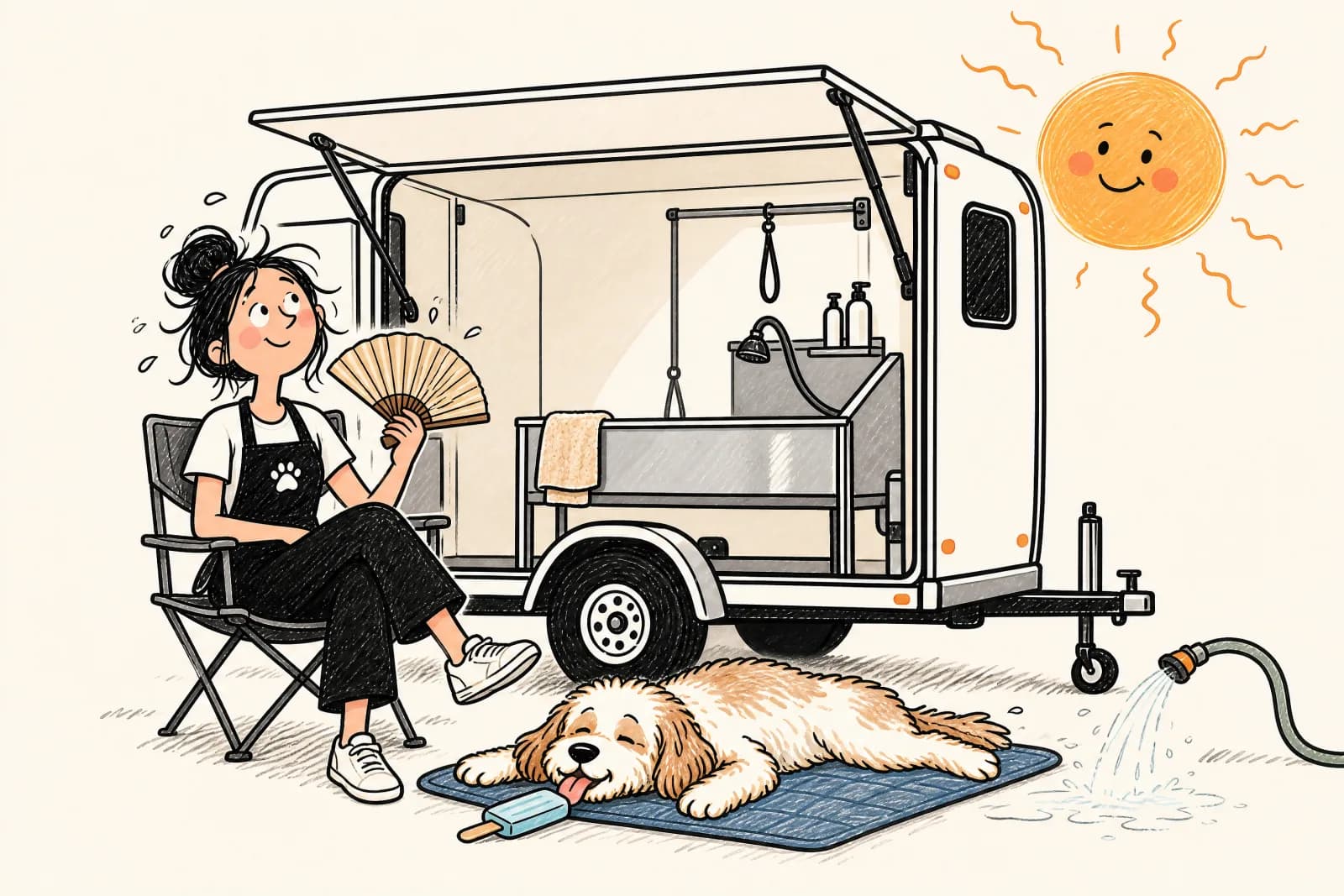
You bought an icy pole at the servo at 11am. By the time you’d parked, wrestled the hose out and found the one patch of shade on the street, it was an orange puddle on a stick, dripping onto your sneakers.
That’s summer in a grooming van. Everything melts. Including you.
So here’s the short answer, for anyone reading this at 6am with a heatwave on the forecast: start earlier, park for shade, keep air moving, drink before you’re thirsty, take extra care with flat-faced dogs, know the signs of heatstroke without having to look them up, and move bookings on the worst days instead of grinding through them.
The rest of this post is the how.
The hottest places in a grooming van, ranked
First, a quick tour of your rig’s climate zones.
- The cab, air con running. Warm. Bearable. Where you eat lunch and pretend you’re on holiday.
- The bath end. Steamy. Like a day spa, if day spas smelled of wet kelpie.
- The table, mid-afternoon. Hot. The sun comes through the roof like it’s taking it personally.
- Near the back doors, doors shut. Very hot. A pizza oven with a hydrobath.
- The dryer corner. Surface of the sun. Spoken of in hushed tones. Nobody stands there by choice.
It’s funny because it’s true. A van is a metal box full of hot water, hot air and a hard-working human. The dog feels all of it, and can’t tell you.
Know the signs of heat stress in dogs
This is the bit to know cold. RSPCA Australia lists the signs of heatstroke in dogs as constant panting, rapid breathing and heart rate, pale or red gums, drooling, vomiting, diarrhoea, dizziness, weakness, lethargy, confusion, muscle tremors, seizures, little to no urination and collapse.
Some of those are easy to miss on the table, because plenty of dogs pant and drool at the groomer’s anyway. So watch for the change. A dog who was panting politely and is now panting like they’ve finished a marathon, or whose gums have gone a different colour since the bath, is telling you something.
RSPCA calls heatstroke a life-threatening emergency that can lead to rapid multi-organ failure. If you suspect it:
- Stop the groom. Nothing about the trim matters now.
- Get the dog somewhere cool, shaded and airy, with a fan or air con going.
- Put room-temperature or cool water on their fur and skin. RSPCA Queensland warns against ice-cold water, which may make things worse.
- Call a vet and get the dog there straight away. Ring the owner on the way.
Even if the dog seems to perk up, they still need a vet. RSPCA Queensland points out that organ damage can show up later.
Which dogs are most at risk
RSPCA’s list of higher-risk dogs reads a bit like a groomer’s client book: overweight dogs, very young and very old dogs, and flat-faced (brachycephalic) breeds, which can’t cool themselves as well by panting. It also flags poor airflow and warm, humid conditions, which is a fairly accurate description of a van after the third bath of the day.
Flat-faced breeds need the gentle treatment
Pugs, Frenchies, British bulldogs and friends have to do their cooling through a face that wasn’t built for it. On hot days:
- Book them first thing, while the van is at its coolest.
- Keep the groom short and break it up. A breather with the doors open beats pushing through.
- Go easy on heat from the dryer and keep air moving.
- Watch their breathing the whole time. Some are noisy breathers at the best of times, so you’re looking for a change, not just noise.
If a flat-faced dog is getting distressed, stopping and finishing another day is a completely professional call. The fringe can wait.
Shift the day earlier
Safe Work Australia’s advice on managing the risks of working in heat includes scheduling physically demanding work for the cooler parts of the day. Grooming is about as physically demanding as a job gets without a hard hat.
In summer, that usually looks like:
- Start early. The 7am groom is a different job to the 2pm one.
- Put the big, thick-coated dogs first and the quick tidy-ups later.
- Keep the hottest part of the afternoon light, or empty if your bookings allow.
- Finish early rather than squeezing in one more.
Park for shade, not convenience
Where you park can change the whole job.
- Look for shade on the side of the van that opens, not just over the cab.
- Think about where the sun will be in an hour. The tree that’s perfect at 9am can be useless by half ten.
- Ask whether you can pull into the driveway, beside the house or under the carport. Plenty of clients will say yes.
- Mind the ground. RSPCA notes that concrete, sand, bare ground and even dry grass can get dangerously hot, so think about the walk between the front door and your van, too.
Ventilation and drying in a humid van
Water plus heat plus a closed box equals humidity, and humidity makes it harder for everyone in there, dog and groomer, to cool down.
- Get air moving through the van. Open doors on both sides, run the roof vent or exhaust fan, and point a fan so it pushes hot air out.
- If your rig has air con, give it a head start before the first dog.
- Dry on cooler or lower settings where the coat allows. It takes longer, but it doesn’t turn the whole van into the dryer corner.
- Never leave a dog unattended while drying. Stay with them and keep watching their breathing.
- Between dogs, open everything up and let the van breathe for a few minutes.
And the big one: RSPCA says never to leave a dog in a vehicle, even on an overcast day with the windows down. A dog waiting in a shut van while you chat at the front door counts.
Look after yourself, too
You’re not a dog. You are, however, a mammal standing next to a dryer in January.
Safe Work Australia’s first-aid guidance points out that thirst is satisfied before your lost fluid is fully replaced. Translation: by the time you feel thirsty, you’re already behind.
- Keep a big bottle of cold water in the cab and refill it at every stop.
- Drink regularly, not just when you’re parched.
- For dehydration, Safe Work Australia’s first aid is water, and avoiding caffeinated, fizzy and alcoholic drinks. The iced latte is a treat, not a hydration plan.
- Wear light, breathable clothes.
- Take proper breaks in the shade or the air-conditioned cab.
Know the signs in yourself as well. Safe Work Australia lists heat stroke symptoms including thirst, sweating, a raised body temperature, weakness, headache, dizziness, nausea and muscle cramps. Severe signs include sweating stopping altogether, clumsiness and confusion. If you think someone has heat stroke, the advice is to call an ambulance immediately.
When you work alone, that someone might be you. Let a person know where you’re working that day, and don’t push through feeling rotten.
The "just shave him for summer" conversation
Every summer, someone looks at their fluffy double-coated dog and says the words. "Just shave him off. He must be boiling."
It comes from a kind place. But it’s not as simple as it sounds, and vets don’t all agree on it.
The American Kennel Club’s chief veterinary officer argues against shaving double-coated breeds, saying the coat helps protect them from heat and sunburn, and that the undercoat can grow back faster than the guard hairs and leave the coat patchy. An Adelaide vet at Walkerville Vet takes a different view: he calls the idea that double coats never grow back a myth, says clipping can help some dogs with temperature control, and notes that guard hairs can take around six months to fully regrow.
Where they line up:
- A freshly clipped dog can be more prone to sunburn, especially in the first few weeks.
- Clipping is not a substitute for regular coat care.
- Matting is a fair reason to clip.
So the chat is less "yes or no" and more "here’s what it means for your dog". Something like:
- Ask why. Is the dog struggling in the heat, is it matting, or is it the look of all that fur in February?
- Offer the alternatives. A thorough de-shed to clear out loose undercoat, and a tidy of the belly, feet and sanitary areas.
- Explain the trade-offs if they still want a clip: sun protection, a coat that may look different for months, and brushing that still needs doing.
- Point health questions to their vet, especially for older dogs or dogs who already cope badly with heat.
Then pop their decision in the dog’s notes, so you’re not having the same chat next January.
Rescheduling on extreme-heat days without losing the booking
Some days the right move is not to groom, or at least not at 2pm. Safe Work Australia even gives cancelling outdoor work in high temperatures as an example of removing the hazard altogether. Keep an eye on the Bureau of Meteorology’s heatwave forecasts when a hot week is coming, and make the call early.
The trick is moving bookings without losing them:
- Decide the night before, or earlier. A text at 6pm lands far better than a call from the kerb.
- Offer a time, not a question. "Can we do 7am Thursday instead?" gets a yes faster than "When suits?"
- Pull the day earlier before you cancel. Often you only need to start two hours sooner and be done by lunch.
- Keep it about the dog. "It’s forecast to be 41 on Tuesday and I don’t want Biscuit in a hot van." Nobody argues with that.
This is where Clippers Base earns its spot in the cab. It shows the weather where you’re working, so the forecast sits right next to your day. When you move a booking, there’s a "rescheduled" text that goes from your own mobile number, and a "running late" one for the days that get away from you. You can change the wording, and clients reply to you as normal.
A summer checklist for the van
- Start early, heavy coats first.
- Park for where the shade will be in an hour.
- Air moving, air con on, doors open between dogs.
- Low-heat drying, never unattended.
- Water for the dog, water for you.
- Flat-faced dogs: early, short and gentle.
- Know the heatstroke signs. Cool with cool water, not icy, and call a vet.
- Move bookings early on extreme-heat days.
The good news is that most dogs get through summer grooming just fine when the day is planned around the heat. They get a bath, a blow-out and a nap on the cooling mat.
You get the dryer corner.
So refill the bottle, sit in the shade for five minutes, and let Clippers Base carry the "rescheduled" texts when a heatwave rolls in. The dog’s fine. It’s you we’re worried about.
This is general information, not veterinary or medical advice. If you think a dog has heatstroke, contact a vet straight away. If a person might, call 000.
Sources
- How can I protect my dog from heatstroke? (RSPCA Knowledgebase)
- Heatstroke and staying cool (RSPCA Queensland)
- Working in heat (Safe Work Australia)
- Working in heat, managing risks (Safe Work Australia)
- First aid for heat-related illness (Safe Work Australia)
- Heatwave (Bureau of Meteorology)
- Should you shave your dog in the summer? (American Kennel Club)
- Can all dog breeds have summer haircuts? (Walkerville Vet)